
How to Bulk Edit Etsy Listings Safely: A Practical Guide
A calm, repeatable way to update many Etsy listings while protecting the details that make each one work.
To bulk edit Etsy listings safely, start with a precisely selected group, make one type of change at a time, and review a small test batch before updating the rest. Etsy’s own tools may be sufficient for small changes, while dedicated listing-management software can make larger jobs easier to organise and verify.
It is a Sunday night in late October. Your dispatch time is moving from three days to five for the holidays, and forty listings say “Ships in 1–3 business days” in the description. You run one find-and-replace and go to bed. On Tuesday a customer asks how to add the name for their engraved necklace; the listing no longer says. Your stomach drops: there, the shipping line and the personalization instructions shared a paragraph, and the replacement took both. Eleven more listings look the same, and the original wording is gone.
The answer is not to change everything at once. It is to make the work smaller, more consistent, and easier to review. This guide covers when bulk editing helps, which approach fits the job, and a practical system for making changes without flattening the useful differences between your products.
Why bulk editing matters
Most Etsy shops grow one listing at a time. That is a sensible way to learn what customers respond to, but repeated details eventually spread across dozens or hundreds of listings. Materials, production partners, shop policies, shipping notes, and recurring title patterns can drift as the catalogue grows.
Updating those details consistently matters for more than neatness. Accurate information helps shoppers make informed choices, reduces avoidable questions, and makes the shop easier for you to maintain. A shared change, such as a new care instruction, should not take an afternoon of opening listings one by one.
Bulk editing also makes improvement practical. If you have learned that your audience searches for a particular phrase, you can review a set of related titles together rather than relying on memory. The goal is not to make every listing identical. It is to handle the repeated part once, then give each product the attention it still needs.
Common Etsy bulk-edit frustrations
The first frustration is finding the right listings. Search results can mix products that look similar but need different wording, or hide listings because you remember the wrong phrase. A broad selection is fast, but it increases the chance of changing something that should stay untouched.
The second is losing context. Titles, tags, descriptions, photos, variations, and inventory all tell part of the product story. Editing one field in isolation can create awkward wording or a mismatch between what the title promises and what the options actually offer.
The third is uncertainty about what has already changed. Etsy’s tools and manual workflows can make it difficult to compare a large set, record decisions, and return to a skipped listing later. Sellers often compensate with browser tabs, copied spreadsheets, or notes that quickly become another project to maintain.
Finally, bulk does not mean risk-free. A typo copied into one listing is inconvenient; copied into eighty, it becomes a cleanup exercise. Reliable bulk work needs a clear selection, a small change, and a review before anything is saved or published.
Choose the right approach for the job
For a handful of listings, Etsy Shop Manager may be all you need. Open the listings, make the same narrow change, and check each result. This is a good fit when the group is small or when every item needs close attention.
For a structured catalogue, a spreadsheet can help you plan. Export or copy the fields you need, add a column for the proposed change, and use filters to define the target group. Treat the sheet as a review plan unless you are certain about the import behavior: a spreadsheet does not automatically protect Etsy-specific fields or resolve conflicting edits.
For a larger catalogue, listing-management software can reduce repeated navigation. Useful tools let you search across relevant fields, select a precise group, make consistent changes, and review what will be sent before it reaches Etsy. Compare tools based on their safeguards and field support, not just how many listings they can update in one click.
Practical tip: Choose the least complicated tool that can safely complete this particular change. A ten-listing title review does not need the same process as a shop-wide shipping update.
A safer bulk-edit workflow
Start by writing the change in one sentence. “Add the new care instruction to the description of ceramic mugs” is easier to verify than “clean up descriptions.” Include what should change, which listings are in scope, and what must not change.
Next, define the group using a stable signal: product type, section, SKU pattern, or a deliberate set of listing IDs. Read the results before selecting them. If two products share a phrase but not a use case, split them into separate groups rather than trying to write one universal sentence.
Make one kind of edit at a time. Update the care instruction first; review and save that group; then move to titles or tags as a separate pass. Narrow edits are easier to spot and simpler to undo than several unrelated changes bundled together.
Before applying the change broadly, test it on a small representative group. Include an ordinary listing and an edge case, such as a personalized item or a product with several variations. Check the final title, description, tags, price, and options in the same way a customer would read them.
Keep a short change log with the date, target group, field, and reason. One plain sentence per edit is enough, for example: “30 September: ceramic mugs section, 18 listings, description: added the new dishwasher-safe care line because the glaze changed.”
After saving, compare a few changed listings with their earlier state and verify the total count. If the platform or tool offers a preview, use it. If it offers a restore point or backup, confirm that it completed before the edit begins.

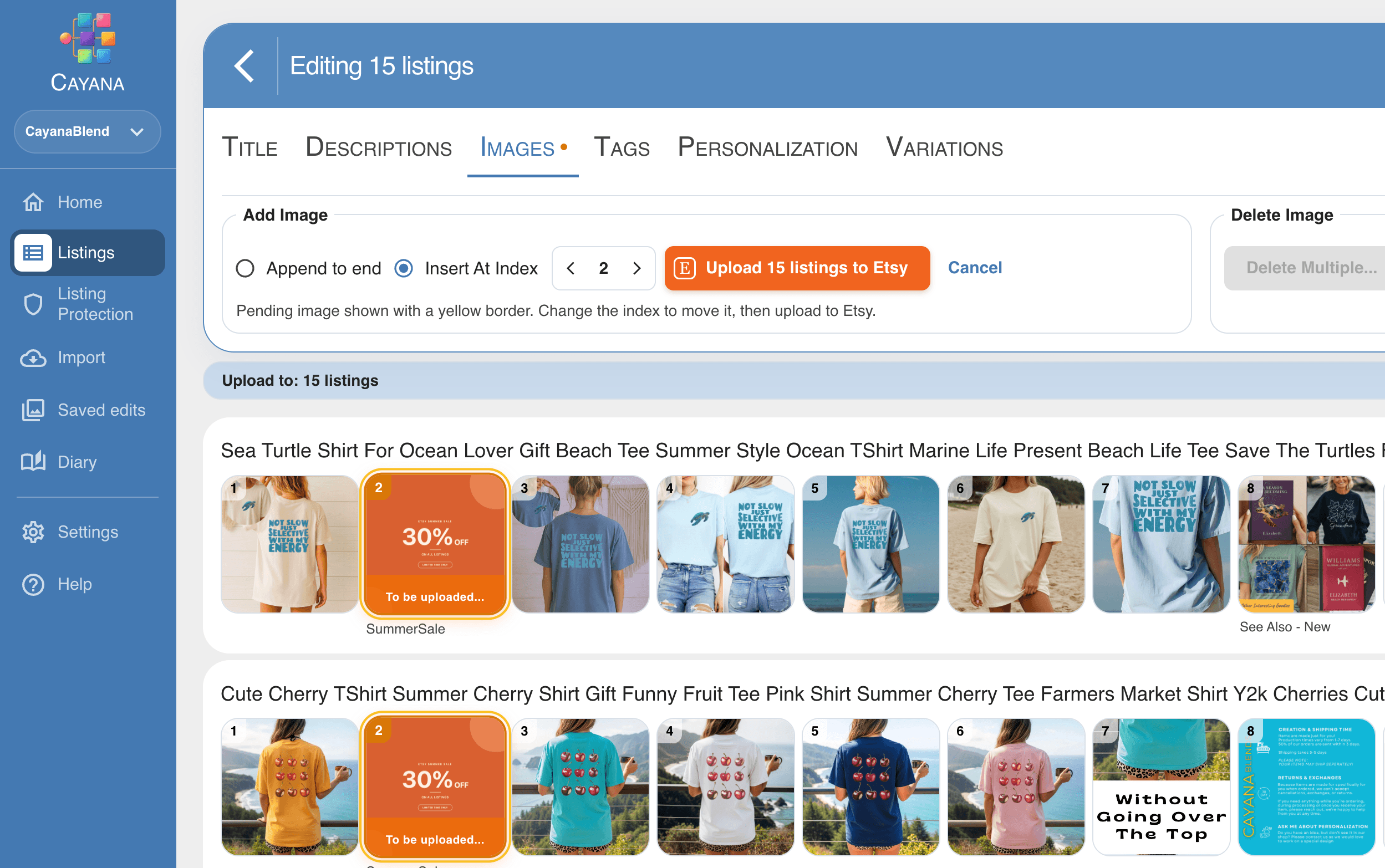
For a visual example, see how to bulk edit Etsy listing images, from choosing a shared image to reviewing its position before uploading.
Keep listings organized between edits
Good organization makes future bulk work much less stressful. Use shop sections that describe how customers browse, and keep internal product identifiers stable enough to distinguish similar items. A short naming pattern for SKUs can help you find products without relying on titles that change for search or seasonal reasons.
Keep a small source of truth for details that repeat: materials, dimensions, care instructions, production partner information, and approved brand language. Review that reference when a product changes. Do not paste every shared phrase into every listing automatically; check that it is still accurate for each item.
It also helps to separate routine maintenance from experiments. If you are testing a title format, record the listings and the date, then avoid changing several other fields at the same time. That way, if the result is disappointing, you can identify what changed instead of guessing.
A few habits that prevent cleanup
- Save the original wording or use a backup before a large edit.
- Start with a small group and inspect the saved result before continuing.
- Keep personalization, materials, sizing, and variation details specific to each item.
- Avoid editing listings that are already being updated by another person or process.
- Leave time to review after the change; a successful save is not the same as a good listing.
Bulk editing should make careful work easier, not remove the care. The best process combines a precise selection, a focused change, and a human review. When those three steps are clear, even a large catalogue becomes manageable.
Frequently asked questions
Can I bulk edit every Etsy listing field?
No. The fields available depend on Etsy’s current tools and on the software you use. Check the supported fields before planning a large change, and never assume that an import or bulk action preserves fields it does not explicitly show.
Will bulk edits affect my search visibility?
They can. Titles and tags carry the most risk because Etsy uses them to match listings to searches. Fixing typos, correcting attributes, updating shipping or care details, and replacing a low-traffic tag are lower risk. Rewriting a bestseller’s title, removing words its buyers already search for (check Etsy Stats first), or reworking a whole section’s titles at once are higher risk. Test title changes on a few lower-traffic listings, judge them after two to four weeks, and avoid shop-wide title or tag changes in the month before or during your busiest season.
How many listings should I edit at once?
For a first batch with a new tool or edit type, start with five to ten listings, including at least one personalized item and one with variations. That reveals edge cases while staying small enough to check every saved listing by hand. If it needs no corrections, move to groups of twenty to thirty. After two clean batches in a row, apply the edit to the rest.
Does Cayana Studios update my shop automatically?
Cayana Studios is a listing-management workspace. You choose the listings and edits; review the proposed changes and decide when to send them to Etsy. As with any connected tool, confirm the current field support and preview before applying a large update.
Related articles
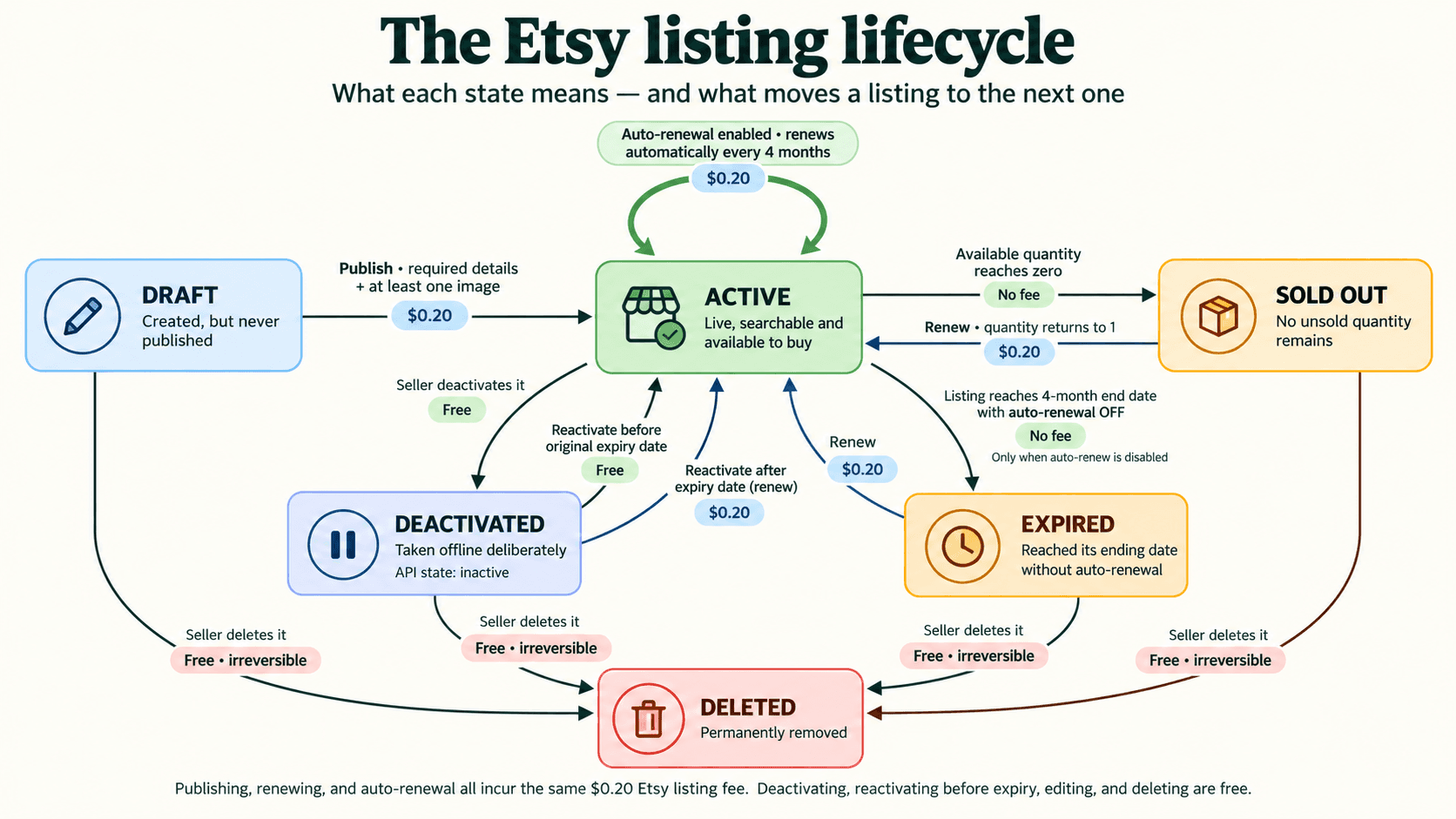
Etsy Listing States Explained: From Draft to Deleted
Ever wondered what each Etsy listing state means—or how a listing moves from one to another? Here is the quick version.
Read article

Why I Started Cayana Studios
I built Cayana after experiencing the repetitive work of running an Etsy shop—and believing that listing management could feel clearer, calmer and safer.
Read article
Trying an Etsy Listing Tool Before You Subscribe
Looking for a Vela alternative you can try free? Here’s where I’d start with Cayana—and why I’d try it on five listings before anything else.
Read article